
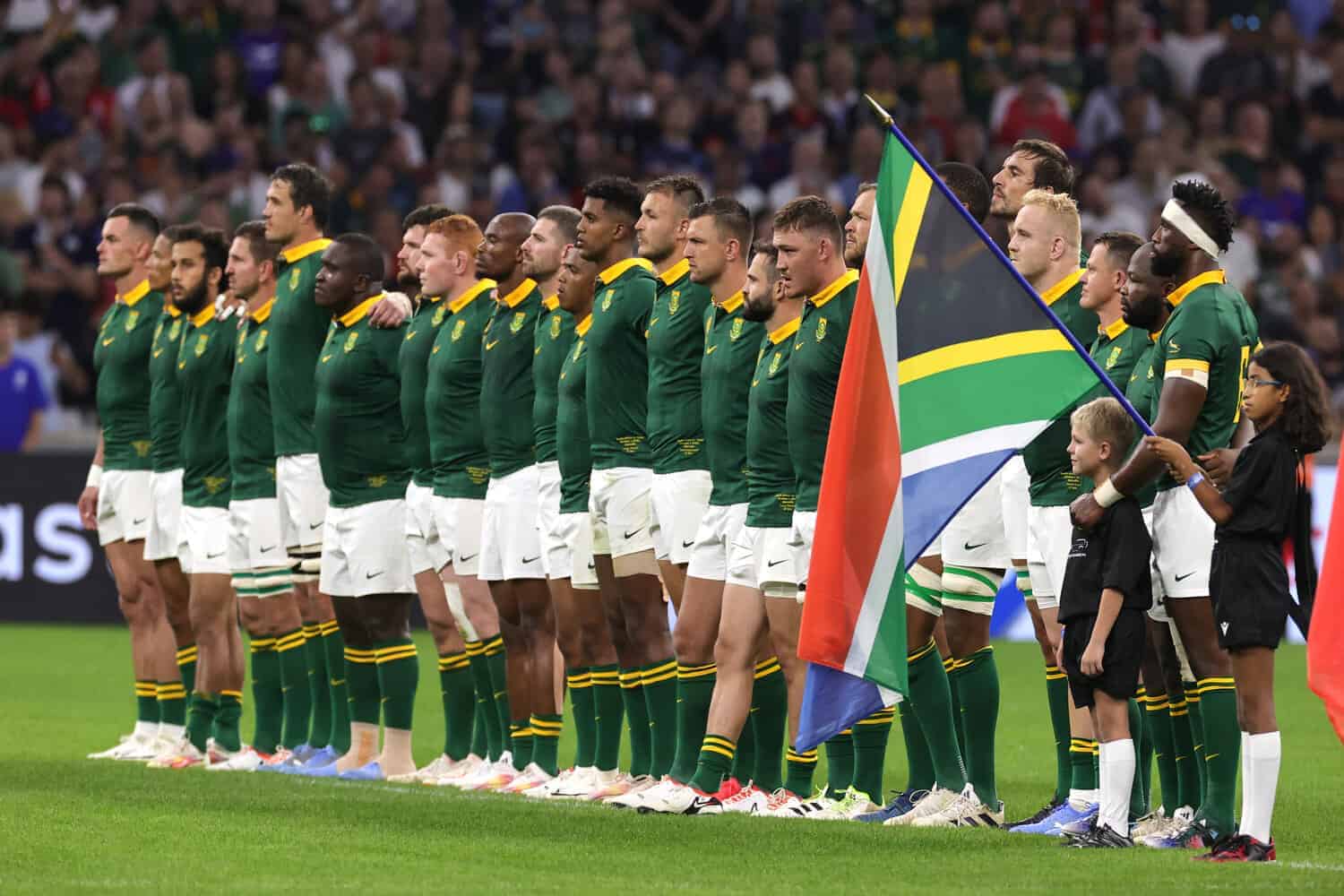
The 2027 Rugby World Cup Pool Draw has handed South Africa a familiar mix of grit and promise, with the Springboks landing in Pool B alongside Italy, Georgia and Romania, and a potential quarterfinal showdown against New Zealand lurking if both giants win their groups. Drawn in Sydney, the bracket paints a path that looks straightforward at first glance, yet it is laced with the kind of jeopardy that defines World Cups.
What the draw means for South Africa
South Africa will defend their crown in Pool B against Italy, Georgia and Romania, opponents the Springboks have handled historically, though not without reminders to respect every step. Italy are ranked 10th, Georgia 13th and Romania 22nd, and the Boks have lost to only one of them in their history, that 2016 slip in Florence against Italy.
Rassie Erasmus welcomed the shape of the group while striking the right cautionary note that has become a hallmark of his tenure. The Springboks have beaten all three in previous World Cup meetings, Romania in 1995 and 1999, Georgia in 2003 and Italy in 2019, yet Erasmus knows reputations count for little once the whistle blows.
“We are pleased with the pool we have been drawn in, but this is a World Cup, and every team will go out there with great passion and do their utmost to represent their nations with pride,” said Erasmus. “There have been surprises in the tournament before, so we’ll need to be up mentally and physically for every match.”
That sentiment is grounded in 2025 reality. Italy fell three times to the Springboks this year, 42-24 in Pretoria, 55-10 in Gqeberha and 32-14 in Turin, where South Africa spent much of the second half with 14 men. Erasmus also pointed out that scorelines can hide the fight Italy brought to those contests, a reminder that pool play punishes complacency.
The collision course with New Zealand
The real drama hums in the knockout scaffolding. South Africa’s Pool B aligns with Pool A for the quarterfinal route, which means if the Boks top their pool and New Zealand win Pool A, the 2023 finalists could meet as early as the last eight. Pool A features hosts Australia with New Zealand, Chile and Hong Kong China, and the cross-Tasman rivals are expected to decide top spot between them.
Before any quarterfinal, the expanded format introduces a round of 16. The Boks, should they win Pool B, would likely face one of the four best third-placed teams. That is a game to build momentum, yet the quarterfinal then tilts toward the Pool A winner, which is the fork in the road where titles are often won or lost.
“Along the way you’re going to play potentially No 1, two and three in the world and it might not be in the final,” said All Blacks captain Scott Barrett. “So that’s the beauty of the World Cup. You’re going to have to peak at the right time.”
All Blacks coach Scott Robertson struck a similarly clear tone. If the bracket does deliver that rivalry early, New Zealand will lean into it rather than look away. Mindset and timing, he suggested, will be everything.
“You’re coming into a World Cup, you’re going to have to face someone in form to win it,” said Robertson. “So if the quarterfinal fits the way it works out, that’s the best part of the draw. You embrace it.”
How the expanded format reshapes the road
The 2027 edition grows to 24 teams and six pools of four, which changes the rhythm of the tournament. There will be 52 matches, and while the event is shorter in calendar length than 2023, 43 days compared to 50, the path to the title remains a seven-game march for any finalist, three in the pool stage then a round of 16, quarterfinal, semifinal and final.
The qualification picture is broader too. The top two in each pool qualify for the round of 16, joined by the four best third-placed teams. The knockout bracket has been mapped out in advance. Winners of Pools A, B, C and D will play against the four best third-placed teams, while the winners of Pools E and F will face the runners-up from Pools B and D. The runners-up in Pools A and C will meet the second-placed teams from Pools E and F, a structure that rewards pool winners yet still tests depth and adaptability.
Dates and host cities in Australia
The tournament runs from 1 October to 13 November 2027, returning the men’s Rugby World Cup to Australia for the first time since 2003. The opening match will feature the Wallabies at Perth Stadium on Friday, 1 October, with the final booked for Sydney’s 83,000-seat Accor Stadium on Saturday, 13 November.
Once the pools were set, attention turned to venues and scheduling. World Rugby and the local organisers will unveil the full match schedule on Tuesday, 3 February 2026. Matches will be staged across Adelaide, Brisbane, Melbourne, Newcastle, Perth, Sydney and Townsville, a spread that promises variety in atmosphere and conditions as the tournament unfolds.
Pool by pool snapshot
- Pool A Australia, New Zealand, Chile, Hong Kong China
- Pool B South Africa, Italy, Georgia, Romania
- Pool C Argentina, Fiji, Spain, Canada
- Pool D Ireland, Scotland, Uruguay, Portugal
- Pool E France, Japan, USA, Samoa
- Pool F England, Wales, Tonga, Zimbabwe
Form guide and head to head
Italy arrive as the highest-ranked of South Africa’s group opponents, and recent meetings underline South Africa’s scoring punch and Italy’s resilience. Across Pretoria, Gqeberha and Turin in 2025, the Boks piled up points yet were made to work in the tight exchanges, which is why Erasmus cautioned against reading too much into margins.
Georgia have a history of physical front-row excellence and never die wondering at the contact zone. The Springboks have beaten them three times, conceding few opportunities while scoring at least 40 each time, including a 55-10 result in Gqeberha in July. For a team like South Africa, the battle up front is a barometer, and Georgia always make that fight meaningful.
Romania round out the group and bring the kind of pride that these tournaments spotlight. They met South Africa at the 1995 World Cup in Cape Town, a 21-8 Springbok win, and most recently in 2023 in Bordeaux, where South Africa won 76-0. History leans green and gold, but the lesson of World Cups is simple enough, get your work done early and give nothing away.
Why Pool A shapes the bracket
Pool A may be the most consequential for the title race, not only because it features the hosts and the All Blacks, but because its winner likely faces the Pool B winner in a quarterfinal. That is a heavyweight collision tucked into the middle of the tournament, with the winner eyeing a semifinal against a side emerging from the quadrant that includes France and the runners-up of Pools D, C and F.
There is also a broader competitive balance at play. Analysts have noted that the early meeting between South Africa and New Zealand could ease another contender’s route. One view suggests England, grouped with Wales, Tonga and Zimbabwe in Pool F, may enjoy a more navigable path if seedings hold. That strand of analysis reflects how the enlarged format can both widen opportunity and compress the biggest battles into earlier rounds.
Rassie Erasmus sets the tone
Erasmus’s response to the draw matched the standard he demands, calm, respectful of opponents, and grounded in preparation. The focus is on the next task, a habit that has served the Springboks through four world titles, 1995, 2007, 2019 and 2023, the most of any nation.
His squad has been in formidable form, retaining the Rugby Championship and finishing the Autumn Nations Series unbeaten in 2025. Reports from the draw framed South Africa as favorites again, not least because they edged New Zealand 12-11 in the 2023 final in France, a result that still echoes in the rivalry’s modern chapter.
New Zealand embrace the challenge
The All Blacks, three-time world champions, are not shy about the road ahead either. The potential Perth opener against the Wallabies sets their tone, and there is further context in the calendar. New Zealand are due to tour South Africa in 2026 for a traditional series billed as the Greatest Rivalry, with Tests in Johannesburg and Cape Town and another at a neutral venue, a prelude that adds spice to any 2027 rematch.
Barrett’s message was pointed, peaking matters more than placement. Robertson’s was proactive, treat every bracket turn as another chance to have a crack. That mindset fits the All Blacks’ identity and ensures a likely quarterfinal, if it comes, will be about momentary excellence rather than fear of the draw.
The bigger picture for fans
For supporters plotting their journeys, the expansion to 24 teams widens the global map. Hong Kong China appear in their first World Cup, while Zimbabwe return for the first time since 1991. Spain and the USA add fresh narrative threads, and the presence of established disruptors like Fiji, Japan, Samoa, Portugal and Georgia means every pool has a storyline.
Australia’s hosting canvas brings sunlit afternoons and big-city nights, from Perth’s modern cauldron to Sydney’s grand stage. The schedule reveal on 3 February 2026 will allow fans to circle dates, this is when the pilgrimage truly begins, while for teams the window between draw and kickoff becomes a study in planning, squad depth and adaptability.
What comes next for the Springboks
From here, the job is to build rhythm and resilience. The round of 16 could be the place to fine-tune combinations, but the Boks will know that every minute counts once they reach the quarterfinals. If it is New Zealand, it will arrive with the intensity of a final, and if it is Australia, the home crowd will test composure in different ways. Either way, South Africa’s standards will decide how far they travel.
In the end, the draw offered clarity more than comfort. South Africa have a pool they can control, then a potential gauntlet that will measure their ambition. For a team chasing an unprecedented third straight world title, that feels about right. The world is coming to Australia, the bracket is set, and somewhere in the noise of Perth and the roar of Sydney, champions will be forged again.